Last ceremony before today
January 3, 2025
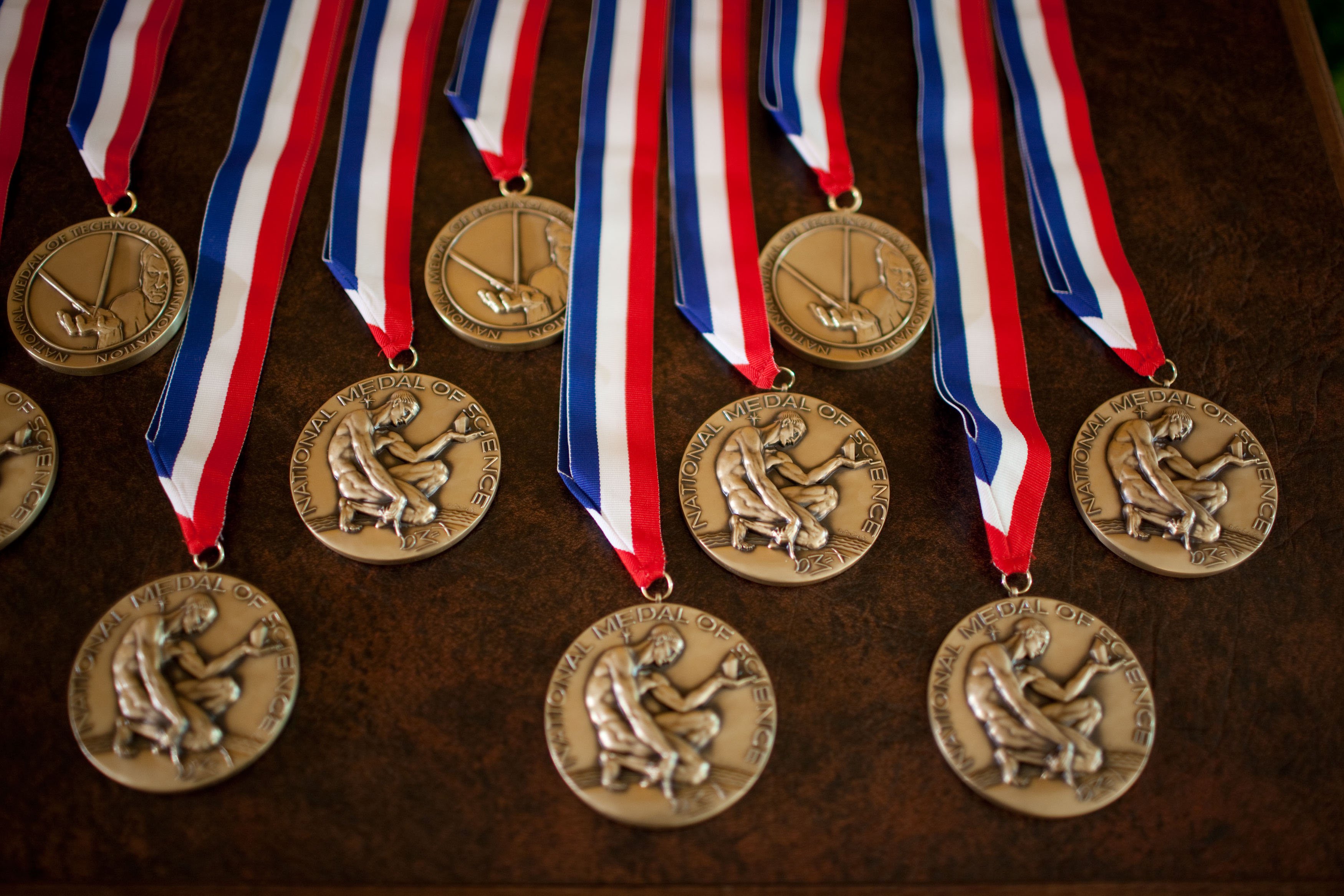
The Biden White House presented National Medals of Science and of Technology and Innovation. Coverage here is from the National Science and Technology Medals Foundation.9
Compiled Oct 8, 2026 · America/Edmonton
Full verified lore. Every claim below is tied to a primary or official source. Nothing here is inferred, and nothing unsourced is filled in.
Statute
Aug 25, 1959
Public Law 86-209
First medal
Award year 1962
Presented Feb 18, 1963
Metal
Bronze
Struck 3¼ inches
Annual cap
20
Individuals, not institutions
NSF tally
529
Page updated Oct 6, 2026
Compiled
Oct 8, 2026
America/Edmonton
The 529 figure is NSF’s published tally as of a page update on Oct 6, 2026. Today’s four science medals are additional unless NSF has already rolled them in.
01 — Origin
Congress created the honor in August 1959. The first medal, for award year 1962, was presented by President Kennedy in February 1963.
Congress established the National Medal of Science in Public Law 86-209, approved August 25, 1959 (H.R. 6288; 73 Stat. 431). The act directed the President, on NSF recommendations, to prescribe the medal’s design, materials, and inscriptions, and to award it to individuals for outstanding contributions to knowledge in the physical, biological, mathematical, or engineering sciences.
Presentation was to be by the President “with such ceremonies as he may deem proper.” The cap was not more than twenty individuals in any one calendar year. Citizenship rules, and rules for a permanent resident seeking naturalization, were in the statute from the start.14
The first medal was for award year 1962. President John F. Kennedy presented it on February 18, 1963, in the White House Flower Garden, to Theodore von Kármán of Caltech and JPL, the sole first recipient.
“…it is a great pleasure for me to select you as the first recipient of the National Medal of Science.”
NSF citation — Theodore von Kármán
“For his leadership in the science and engineering basic to aeronautics; for his effective teaching and related contributions in many fields of mechanics, for his distinguished counsel to the Armed Services, and for his promoting international cooperation in science and engineering.”
02 — Design
Executive Order 10910 fixed the metal, the picture, and the parchment citation. A later order changed the committee, not the medal.
President Dwight D. Eisenhower signed Executive Order 10910 on January 17, 1961, prescribing the medal’s design under the 1959 act. His presidency ended January 20, 1961 — three days later.2
NSF: the medal was sculpted by medallic artist Donald DeLue, also known for the Omaha Beach sculpture and the Boy Scout Memorial in Washington, D.C., from a design by Richard H. Bolt, then an NSF associate director for planning with a fine-arts background. Eisenhower approved that design in EO 10910.4
Medallic Art Company collector documentation describes the reverse as a field of stars over abstract ocean waves, with the legend “AWARDED BY / THE PRESIDENT / OF THE / UNITED STATES / OF AMERICA / TO.” Diameter about 80 mm. Striker: Medallic Art Company of New York. Catalog 1960-025.7
President Lyndon B. Johnson signed EO 11287 on June 28, 1966 (31 FR 8995). It did not rewrite the bronze, 3¼-inch design of EO 10910.3
03 — Selection
Peers nominate. A presidential committee recommends. The President decides. The fields grew once, in 1980. The cap did not.
Current NSF process: peers nominate, with a form and supporting letters. Three letters from outside the home institution are required. Nominations go to the President’s Committee on the National Medal of Science — today, 14 presidential appointees plus 2 ex officio: the Assistant to the President for Science and Technology (the OSTP director), and the President of the National Academy of Sciences. The President makes the final award. The White House announces.4
Eligible fields
Physical, biological, mathematical, engineering.
NSF history: AAAS urged adding social and behavioral sciences; Sen. Edward M. Kennedy’s bill; Carter signed PL 96-516, expanding the medal to behavioral and social sciences.
Physical, biological, mathematical, engineering, or social and behavioral. Examples listed include astronomy, chemistry, CISE, geoscience, materials, and STEM education research.
Expansion history is on the NSF medal page.4 Statute text: Public Law 96-516.6
04 — Scale
NSF’s published count is 529. A handful of familiar names show that industry founders are not new to this medal. Gap years are flagged as secondary.
NSF, on a page last updated October 6, 2026, says the medal has been awarded to 529 scientists and engineers since it was established. Today’s four newly presented science medals are additional to that published tally unless NSF has already rolled them in.4
1962 (presented 1963)
Theodore von Kármán
First recipient; engineering / aeronautics.
—
1967 (presented Feb 13, 1968 by LBJ)
Edwin H. Land
Polaroid Corporation. Industry founder and inventor; polarized light, rapid photography, color vision, defense.
1979 (presented Jan 14, 1980 by Carter)
Richard P. Feynman
Caltech. Quantum theory of radiation; also Nobel Physics 1965.
2006 (presented Jul 27, 2007 by G.W. Bush)
Robert S. Langer
MIT. Engineering; controlled-release systems, tissue engineering.
2008 (presented Oct 7, 2009 by Obama)
J. Craig Venter
Genomics; institute founder.
Secondary sources list calendar years with no National Medal of Science, including the years below. Treat the list as secondary unless NSF publishes an official gap table.
Pointer only: Wikipedia, National Medal of Science (secondary pointer only) (opens in a new tab)
Last ceremony before today
January 3, 2025
The Biden White House presented National Medals of Science and of Technology and Innovation. Coverage here is from the National Science and Technology Medals Foundation.9
Latest NSF-published science class before today
2024 laureates
As listed on NSF’s site before today’s announcement.4
05 — Today
Science: A New Golden Age Summit. Citations below are from the White House release issued today. Four science medals, and two of a separate honor.
The White House release says the medals were presented today at the Science: A New Golden Age Summit. Contemporaneous coverage and summit logistics place the awards at the U.S. Institute of Peace — the Donald J. Trump Institute of Peace campus — in Washington. The citation text is from the White House “for immediate release,” October 8, 2026.8
Four citations, in the order of the release.
National Medal of Science
“For engineering achievements of extraordinary ambition and scale that have pushed the frontiers of space exploration, intelligent systems, communications, and beyond, renewing American technological leadership and opening a new chapter in American manufacturing.”
National Medal of Science
“For the development of foundational algorithms for information retrieval and data processing that revolutionized how the world accesses information across science, commerce, and in the course of everyday life.”
National Medal of Science
“For advancing the graphics processing unit into a general-purpose computing architecture through innovations in processor design and software, transforming massively parallel computation and powering breakthroughs in scientific computing and super intelligence.”
National Medal of Science
“For a lifetime of leadership in semiconductor engineering and high-performance computing through innovations in processor architecture and chiplet-based integration that powered the world’s first exascale supercomputer and opened new frontiers in computational performance.”
A separate presidential honor, administered historically via USPTO and paired at ceremonies by the National Science and Technology Medals Foundation. First awarded in 1985, per NSF’s note on the science-medal page.4
National Medal of Technology and Innovation
“For advancing a vision of widespread adoption of personal and enterprise computing; for his technical and business management skills building a worldwide technology company; and for his support for the next generation of American scientists, engineers, and technologists.”
National Medal of Technology and Innovation
“For his transformative leadership of a critical American technology company, which led to its rejuvenation for a new era of cloud computing, and for his construction of the hyperscale infrastructure that enabled the training and global deployment of American super intelligence.”
06 — Not asserted
A missing sentence is not an oversight. These claims were checked and left out because a primary source did not carry them.
Not asserted. No primary source in this pass documented a named second honor that Musk is the first National Medal of Science recipient to hold. Skip until sourced.
Not verified here as a National Medal of Science recipient. Do not treat him as one from this page.
No official source in this research stated either for the 1959 act.
Unspecified beyond the parchment citation, in EO 10910 and the NSF design section retrieved here.
The commonly cited gap list is secondary. It is not presented as an NSF table.
NSF does not publish one. The note on today’s CEOs and co-founders is an observation from the White House release, not a league table.
07 — Sources
Numbered notes in the text point here. Recipient pages that the compilation grouped as one item are listed separately so each opens on its own.
Source 1
Public Law 86-209 (Aug 25, 1959)
https://www.congress.gov/86/statute/STATUTE-73/STATUTE-73-Pg431-2.pdfSource 2
Executive Order 10910 (Jan 17, 1961)
https://www.presidency.ucsb.edu/documents/executive-order-10910-providing-for-the-design-and-award-the-national-medal-scienceSource 3
Executive Order 11287 (Jun 28, 1966)
https://www.archives.gov/federal-register/codification/executive-order/11287.htmlSource 4
NSF National Medal of Science
https://www.nsf.gov/honorary-awards/national-medal-scienceSource 5
Kennedy remarks, first award (Feb 18, 1963)
https://www.presidency.ucsb.edu/documents/remarks-upon-presenting-the-national-medal-science-theodore-von-karmanSource 6
Public Law 96-516 (Dec 12, 1980)
https://www.congress.gov/96/statute/STATUTE-94/STATUTE-94-Pg3007.pdfSource 7
Medallic Art / Donald De Lue, catalog 1960-025
https://medallicartcollector.org/don-de-lue_medals.htmlSource 8
White House release (Oct 8, 2026)
https://www.whitehouse.gov/releases/2026/10/president-trump-presents-national-medals-of-science-and-national-medals-of-technology-and-innovation/Source 9
National Science and Technology Medals Foundation, Jan 3, 2025 ceremony
https://nationalmedals.org/stories/the-white-house-awards-national-medals-of-science-and-national-medals-of-technology-and-innovation/NSF recipient pages
Secondary pointer, not a primary source
Wikipedia, National Medal of Science (secondary pointer only)